Meeting Minutes for October 14, 2012
Mr. Easop: First of all, we have some new members of the USG family, with 5 newly elected members of the freshman class. They’re not here right now, but they exist. Next week we’ll be inviting them. One other note is that Madhu sent out a request for bios for the USG website; if you could please get it in by tonight, it’d be great. I also wanted to welcome Vice Provost Davies to talk about the Student Activities Funding Engine. And finally, is there a motion to approve the minutes? The motion passes.
SAFE
Mr. Kugelmass: As Bruce said, Vice Provost Davies is here to give us an overview of SAFE.
Vice Provost Davies: The Student Activities Funding Engine has been in development for over three years now. We started working on this as an extension of the Travel Registration Database, which is pretty clunky, so we had been making a request to get funding to upgrade it. We started asking around about how much the university spends on travel, but no one could tell us. We thought that was a problem. We starting peeling away at it, and we had an issue with the way Departments and Programs give out money to undergrads for all sorts of things. I’m not including financial aid, salaries, or awards. I’m talking about the money you try to collect from different departments—study abroad, different internships, special projects, junior independent work, going to a conference, going to a club to participate in an event, doing a group service project either abroad or locally. There is no single source for undergraduates to get funding; instead they all go around to different sources. Those offices that do give out funding don’t always know what the whole picture is—no department knows what the other departments are doing. We started thinking about how we could address this issue, so we came up with the idea of a common portal that all undergraduates would go through. It would be a matching system. All the departments that give out money will go through the system with how much money they have, who they give it to, etc. Then you come along later with the information of the opportunity you have, and you go to the “SAFE” to get your money. You’ll say: “I’m doing this internship, I’m going to go to Botswana, I’m an EBB major.” You’ll put in some additional information about when it’s going to be and where it’s going to be. The system will then match you up with the possible funding opportunities that exist for you—then you’ll get all the restrictions (for example: “you can use this money for travel but not for materials.”) Then you complete an application. If recommendations are required or if an advisor needs to comment on your research, then they do that through the single portal. You’ll be able to go in and make changes to the application up until the date of the first deadline. After the fact, if it’s a funder like “dean of the college,” for which you need receipts and reports, you’ll also do that through the portal. You’ll be able to see all of the awards you’ve received. We found that there was no vendor that had anything like this, so we had to create this from scratch. There are going to be three rollout phases. The funders will start next month, students will start in January, and senior-research will start with this round. Internships off-campus starts in the summer. Special projects, junior independent work, conferences will also start in the summer. The second rollout will be groups of students doing things off campus (for example, engineers without borders). The third rollout will be groups of students looking for funding on campus, which is where Projects Board comes into play. We have a small subset of students looking at this to work out the kinks, but once it’s open to the funders in November, we’ll connect the system directly to treasurer systems. This saves the step of having to do the student vouchers. Then we’ll work on the reporting: i.e. how much money did we give out? The last thing I want to say—and this is where it gets a bit complicated—is that there is money that you go and look for and then there is money that is given to you that isn’t requested, and both types of money are going to run through the system. Everything I’ve talked about is “student initiated,” but there are also “funder initiated” programs. These are like PEI or IIP internships where they find the internship and money comes along with it. You don’t have to go asking for money that’s already been given to you, so the funders will go and put it in the system. I’d now be happy to take any questions you have!
Mr. Kugelmass: Also—as USG, we’re putting out an open application for students to be part of a larger testing team. We’ll try to get a group of fifteen people from a variety of classes, experiences, majors, programs, etc. And one of the things I hope we’ll talk about today, especially since we have Jared here, is how we see Projects Board fitting in with this.
Mr. Okuda-Lim: Vice Provost Davies, thanks for your presentation! You’d mentioned that in Phase II, you’d be looking for funding for off-campus, group service activities. How would the PACE center fall into the framework of SAFE?
Vice Provost Davies: The nice thing is that all these systems, including PACE, will be encompassed in this system.
Mr. Riley: Will students be able to gage how much funding is offered? How will they determine whether it’s worth applying?
Vice Provost Davies: Departments will have to state how much money they tend to give. The other thing is that we wanted to make it so that students weren’t punished for being proactive and thinking in advance. Even if a cycle hasn’t opened yet, you’ll be able to see the funding available and when it opens for application. And I think that in time, a lot of these funders who have been functioning in a vacuum will be able to see how they fit in the larger picture.
Mr. Kugelmass: I’m interested to hear anyone’s thoughts?
Mr. Easop: We have one minute left.
Mr. Peterson: I think it would be great to get a more cohesive funding source for student groups, and it’d make the funding seem more transparent.
Projects Board Presentation
Mr. Peterson: Hi everyone. We see about 330 events every year and we were requested $273,866.71 and we ultimately funded $143,040.66. The first item we have up for approval is first is the PDA Down Syndrome conference, for which we tried to avoid giving money that didn’t go to non-Princeton children.
Mr. Easop: How does the Venture Fund play into this?
Mr. Peterson: We wanted to originally put $200 towards PDA Down Syndrome Conference and $800 towards LGBT Awareness Week from Venture Fund, but these events were presented at the very beginning of the year and the Venture account had not yet been had funds transferred into it, which we were initially unaware of.
Mr. Easop: The PDA event has occurred in the past. But in the past, has it been funded over $1000 from USG or from Venture Fund?
Mr. Peterson: I don’t know, but their overall budget was smaller this year but they received the same amount from Projects Board. I don’t remember how it was split in the previous year.
Mr. Kugelmass: Is your constitutional requirement that you have to come to us when it’s $1000 or more, or more than $1000 dollars?
Mr. Peterson: We only are required to get Senate approval for funding approval in excess of $1000 from the USG Projects Board account.
Mr. Wagstaff: What is the breakdown of this budget? It’s not clear what the $1000 was originally, or what the $200 or $800 go towards. Are they broken up in different parts?
Mr. Peterson: Projects Board generally does not break down which parts of the budget our funding can be used to pay for, except in circumstances where there are portions of our budget that our charter prevents us from funding. The LGBT Awareness week is going on this week. They are having a fair number of speakers come and talk this week, and there will also be workshops.
Mr. Easop: This LGBT Awareness week was last week, so I guess the money has already come out of the USG account. Was the expectation that Venture Fund would fund it and they refused?
Mr. Peterson: When the event was brought before the Board at the beginning of the year, the Venture fund did not yet have any money in it. The only money that we had at that point was in the USG funds given to Projects Board.
Mr. Easop: Are we expecting to get the money back from Venture Fund?
Mr. Peterson: No, Joe says it would be better to get the USG to approve the funding entirely from USG funds since money was transferred out of the USG PBoard account.
Mr. Kugelmass: Let me try to understand this. Venture Fund gives money to Projects Board that Projects Board allocates.
Mr. Peterson: Yes. In addition, this year they have decided not to fund events on their own in addition to the money they give Projects Board to fund events, so we are the sole provider of VPCL funds.
Ms. Davoudiasl: You’re supposed to come to us before the event occurs, right?
Mr. Peterson: Normally we’d come in before the event.
Mr. Easop: It’s not that Venture Fund declined it, but that the money came from the USG.
Mr. Peterson: It’s that there was no money in the account yet. It was a timing issue.
Mr. Ackerman moves to approve. The motion passes. The motion passes: 16 for, 5 against, and 2 abstentions.
Elections Update
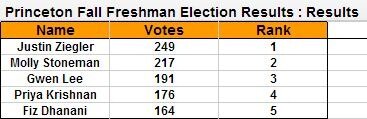
Mr. Dean: Luckily I don’t have as much to say as the last two people. Five new freshmen got elected last week. 674 people voted.
Mr. Okuda-Lim: I wanted to thank you for all your hard work!
Round of applause.
Ms. Davoudiasl: Why were there no runoffs?
Mr. Dean: Because there are only five spots, and they’re all the same.
Ms. Davoudiasl: Did we make any efforts to increase voter turnout?
Mr. Easop: We decided not to do the same type of “question series” for the voters, which would’ve been tiring for voters.
SGRC
Mr. Ackerman: In our meeting on Tuesday, we approved two groups. The first is the Princeton East Asian Popular Culture conference, which is a group dedicated to foster academic discussion of East Asian culture. The second is the Alexander Hamilton society, which is a national organization focused on foreign policy that has speaker series.
Mr. Sharp: How are they different from Whig-Clio?
Mr. Ackerman: They’re not about discussing the issues as a public-speaking venture. This group has a focus on foreign policy.
Mr. Cook: Who is the professor?
Mr. Ackerman: I don’t remember.
Cane Spree
Ms. Shen: The final score was 286 to 206 (freshman to sophomores). There was increased attendance. After they ate food, they were allowed to participate in games on the field and get tickets for t-shirts. We ordered 800 t-shirts and the freshman completely ran out and the sophomores mostly ran out, so I think about 800 people participated, which is good for the first year. The total cost was $6,148.69, so the total cost per student was $4.39 and the USG cost per student was $1.20. Campus Rec relations went really well and they are really excited to work with USG. The climbing wall gave us good feedback and club sports were pretty good, just about cooperating with us. Next year we should push it up in the year, because it was pretty cold. And afterwards, we had a video on the Princeton homepage and an article the Princeton. Lessons that we learned: contact with the athletic teams. Deana had been in touch with them over the summer, but she only heard back from three teams. Our entire event was contingent on their participation. So the approach I ended up taking was an authoritative approach in my emails to the captains (telling them what activity they were doing, etc.) We did get responses, even if some weren’t happy with my approach. I would say that a majority of varsity sports participated, but it’s difficult because fall sports are in season. Another little tidbit is that we want to move the inflatables around. There is an element of “culture change” in here.
Ms. Kim: Could you consider shortening the time?
Ms. Shen: Agreed.
Mr. Rajagopalan: Can we make it more of a mutual interest thing?
Presidential Search Committee
Mr. Easop: The reason we wanted to present on this process is because a) it was a successful process and b) it’s a good protocol for the future. So what we did: we sent out an application with twelve questions that was open to seniors. Then we selected out of those applicants, we selected twelve people to interview. For that interview process, we had two rounds. One was a group interview for 30 minutes, and then an individual 15-minute process. The group interview involved Stephen and I acting as candidates for “President.” We had resumes for the applicants to review, and then gave us 5 minutes to interview the applicant. We followed up that group interview with some individual questions; some that were consistent across applicants and some that were individual. We will find out the final two selected in the coming days. First I think this is great for a talent search-process in general. We can take applications like these and they’re useful for both USG and the administration in general.
Ms. Kim: One of your concerns was that you’d get too many applicants. Did you think that a long 2,000-word application helped narrow the field?
Mr. Easop: We had 149 people start the application, but only 48 actually completed it.
Ms. Kim: So you think this type of model is sustainable?
Mr. Rajagopalan: We have the same type of model for ULC applications, so it is self-selection. The question is—is this good self-selection. Do we only keep Woody Woo’s and people who like to write, and crowd out engineers?
Agenda Setting
Mr. Kugelmass: Stephen suggested that I present on Tiger Ride.
Ms. Kim: Can we have a discussion about expectations for the mentorship program?
Mr. Sharp: Are we having a meeting on Thanksgiving weekend?
Mr. Jackson: Month of Service!
Mr. Easop: Benny—did you want to talk about Dean’s Date in a Senate meeting? Gavin—what about the Sexual Culture Committee week? And the bike rack?
Mr. Sharp: “It’s arrived on campus, and will be installed over fall break.”
Mr. Kugelmass: Should we put people who haven’t sent Project Updates on the agenda?
Mr. Easop: If you don’t want to have a three-hour senate meeting, then you should submit something tonight.
Mr. Berger: Hi guys, I just wanted to introduce myself. My name is Jack Berger, I’m a member of VSAC, and I (or someone else) will be sitting in on Sunday Senate meetings every week to try to bring to USG a varsity athlete perspective.